Introduction
In 2023, a major pharmaceutical manufacturer recalled thousands of units of potassium chloride injection after a labelling error misstated the drug's strength — a mistake that could have caused fatal overdoses. This incident reflects a hard truth: in pharmaceuticals, packaging and labelling are not administrative formalities — they are patient safety imperatives. A single error in dosage instructions, storage conditions, or ingredient identification can trigger regulatory penalties, costly recalls, and serious patient harm.
For manufacturers and procurement teams, navigating pharmaceutical packaging and labelling means understanding several interconnected systems:
- Types of packaging: primary, secondary, and specialised formats
- Mandatory labelling requirements across jurisdictions
- Global and Indian regulatory frameworks
- Quality assurance standards
- Anti-counterfeiting measures
This guide covers each of these in detail.
The scale of this industry makes compliance non-negotiable. The global pharmaceutical packaging market is projected to reach USD 353.09 billion by 2033, growing at a CAGR of 9.9%. India's domestic market alone is valued at USD 5.14 billion in 2025 (approximately ₹42,600 crore). That growth reflects increasing regulatory complexity — and the outsized role that packaging plays in protecting drug integrity and patient safety.
TLDR
- Pharmaceutical packaging falls into three categories: primary (direct drug contact), secondary (outer protection), and specialised formats like child-resistant, tamper-evident, and unit-dose
- Required label elements include drug name, active ingredients, batch number, expiry date, storage conditions, dosage instructions, and manufacturer details — mandated by WHO, FDA, CDSCO, and EMA
- Each market has its own compliance rules — India's CDSCO enforces Schedule H/H1 labelling, the FDA mandates barcoding under 21 CFR 201.25, and EMA governs EU requirements
- GMP compliance means validated packaging processes, documented batch records, label reconciliation at every stage, and audit-ready QC systems
- Holographic labels, serialisation barcodes, and track-and-trace systems are now regulatory requirements in most major markets — not just optional security measures
Types of Pharmaceutical Packaging: Primary, Secondary, and Special
Understanding packaging classification is fundamental to pharmaceutical manufacturing because each type determines material compatibility requirements, regulatory obligations, and quality control checkpoints. The distinction between primary, secondary, and specialised packaging formats directly impacts how products are tested, labelled, and released to market.
Primary Packaging
Primary packaging is defined by regulatory bodies as any component in direct physical contact with the drug product. This includes blister packs, ampoules, vials, bottles, prefilled syringes, and strip packaging. These materials must be chemically inert, non-reactive, and stable throughout the product's entire shelf life.
Key primary packaging formats include:
- Ampoules: Sealed, single-use glass containers for sterile injectables, offering maximum protection from contamination
- Vials: Multi-dose or single-dose containers with rubber stoppers, commonly used for vaccines and biologics
- Blister packs: Unit-dose strips combining thermoformed plastic cavities with aluminium foil backing, ideal for tablets and capsules
- Prefilled syringes: Ready-to-administer devices combining drug storage with delivery mechanism
The choice of primary packaging depends on three key considerations: the drug's route of administration (oral, injectable, topical), dosage form (solid, liquid, semi-solid), and stability requirements (light sensitivity, moisture protection, oxygen barrier).
Secondary Packaging
Secondary packaging refers to outer layers that do not contact the drug directly (cartons, boxes, outer wraps, and protective sleeves). It serves two essential functions: physical protection during distribution and storage, and providing the primary surface for complete regulatory labelling.
Secondary packaging must carry a full complement of mandatory information:
- Product name and batch number
- Storage conditions and expiry date
- Manufacturer name and address
- Patient information and regulatory warnings
Regulations permit certain labelling elements to appear only on secondary packaging when primary containers are too small, provided the two remain together throughout the distribution chain.
Special Packaging Types
Child-Resistant Closures
Certain drug categories require child-resistant packaging by regulation, typically those posing significant poisoning risks. These closures use press-and-turn or squeeze-and-turn mechanisms that children aged 42-51 months cannot easily open, while remaining accessible to adults aged 50-70 years. Performance standards are defined by ISO 8317:2015, which specifies testing protocols to ensure effectiveness.
Tamper-Evident Packaging
Tamper-evident packaging must include one or more indicators or barriers to entry that provide visible evidence of tampering if breached or missing. In India, CDSCO guidelines under Schedule M reinforce this requirement for OTC and over-the-counter products; globally, frameworks such as 21 CFR 211.132 (US FDA) set equivalent standards. Common formats include:
- Film wrappers and heat-shrunk bands around caps
- Inner seals beneath closures
- Breakable cap rings that separate upon first opening
- Void labels that leave permanent marks when removed
Tamper-evident features are mandated particularly for OTC products, where consumers self-administer without healthcare provider supervision.
Unit-Dose Packaging
Unit-dose formats package individual doses separately, reducing medication errors and improving compliance. Clinical evidence demonstrates significant safety benefits: implementation of automated unit-dose dispensing systems reduced medication handling time by 50% per patient per day, while reducing medication errors from 3.2% to 1.7% in hospital settings.
Device Packaging
Specialised formats like prefilled syringes, transdermal patches, and inhalers combine drug storage with delivery mechanisms, improving dosing accuracy and patient convenience while reducing administration errors.
Mandatory Pharmaceutical Labelling Requirements
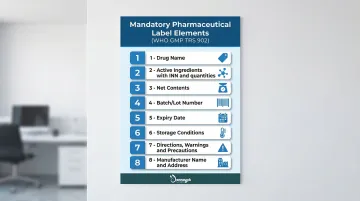
Regardless of market, WHO GMP guidelines (TRS 902, Annex 9) establish universal minimum labelling standards. Every finished drug product label must carry:
- Drug name (proprietary and generic)
- List of active ingredients with International Nonproprietary Names (INN) and quantities
- Net contents (volume or count)
- Batch or lot number assigned by manufacturer
- Expiry date in uncoded, readable format
- Storage conditions and handling precautions
- Directions for use, warnings, and precautions
- Name and address of manufacturer or responsible company
Primary Container vs. Secondary Labels
Primary container labels (on vials, bottles, blisters) typically include abbreviated information: drug name, strength, batch number, expiry date, and route of administration. When containers are too small to accommodate all mandatory elements, regulations permit full information to appear only on secondary packaging—provided the two remain together until dispensing.
Secondary packaging (cartons, boxes) must carry complete labelling: full prescribing information, patient information leaflets, storage instructions, manufacturer details, and all regulatory warnings.
Patient Information Leaflets
Package inserts and Patient Information Leaflets (PILs) translate complex prescribing information into plain language. Regulatory requirements specify:
- Active voice and clear sentence structure
- Minimum font sizes for readability (typically 9-point minimum)
- High contrast between text and background
- Clear headings and logical information hierarchy
These are enforceable requirements, not suggestions — regulators in India, the US, and the EU have each cited illegible PILs as a direct contributor to adverse medication events.
Prescription vs. OTC Labelling
The labelling format differs significantly depending on whether a drug is sold over the counter or by prescription. In export markets such as the US, OTC labels follow a standardised "Drug Facts" format mandated by 21 CFR 201.66, with elements appearing in fixed sequence:
- Active ingredients and quantities
- Purpose of the medication
- Uses (indications)
- Warnings (contraindications, side effects)
- Directions for use
- Inactive ingredients
OTC labels are written for consumers making independent treatment decisions, using simplified language and prominent warnings.
Prescription drug labels follow the Physician Labeling Rule format under 21 CFR 201 Subpart B, designed for healthcare providers. These include "Highlights of Prescribing Information," a detailed Table of Contents, and "Full Prescribing Information" covering pharmacology, clinical studies, dosing, and safety data.
In India, the Drugs and Cosmetics Act and CDSCO guidelines govern equivalent requirements domestically, with Schedule D specifying labelling obligations for imported drugs and export-oriented units subject to additional documentation standards.
Batch Numbers and Expiry Dates
Batch traceability is fundamental to recall management. When a quality issue surfaces, manufacturers must trace the distribution route of specific batches to targeted facilities and patients. Batch numbers enable this precision, preventing unnecessarily broad recalls that disrupt the supply chain.
Expiry dates must appear in uncoded, readable format — not as Julian dates or internal codes. Healthcare providers and patients should be able to determine product viability at a glance, without referencing a conversion table.
Barcode and Unique Identifier Requirements
Regulatory bodies increasingly mandate barcodes encoding unique drug identifiers. 21 CFR 201.25 requires manufacturers to include linear barcodes encoding the National Drug Code (NDC) on most prescription drugs. India's track-and-trace initiatives require barcoding at secondary and tertiary packaging levels for exports.
Barcodes serve two critical functions: reducing dispensing errors at the point of care and enabling supply chain traceability from manufacturer to patient. Research demonstrates that Barcode Medication Administration (BCMA) systems reduce total dispensing errors by 43.95%, with "wrong drug" errors decreasing by 56.85%.
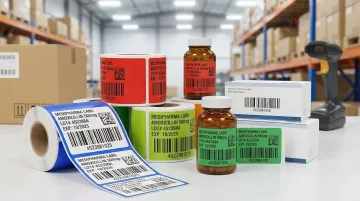
Printed pharmaceutical labels must encode these identifiers accurately and durably — label materials that smear, fade, or delaminate in transit can render barcodes unreadable, defeating the compliance purpose entirely. Gannayak Packaging produces printed pharmaceutical labels with integrated barcode capabilities, built to hold scan accuracy across the distribution chain.
Regulatory Frameworks Governing Pharmaceutical Packaging and Labelling
India — CDSCO and the Drugs and Cosmetics Act
In India, pharmaceutical packaging and labelling are governed by the Drugs and Cosmetics Act, 1940 and its Rules, enforced by the Central Drugs Standard Control Organisation (CDSCO). The regulatory framework establishes specific Schedule requirements:
Schedule H (Prescription-Only Medicines):Labels must display the Rx symbol and the warning: "Not to be sold by retail without the prescription of a Registered Medical Practitioner."
Schedule H1 (Higher-Risk Prescription Drugs):Labels must display the Rx symbol in red and a specific warning box: "It is dangerous to take this preparation except in accordance with the medical advice."
Language Requirements:Under Rule 161, Ayurvedic, Siddha, or Unani drugs must display the caution "To be taken under medical supervision" in both English and Hindi.
Export Track-and-Trace:DGFT Public Notice No. 13/2015-2020 mandates barcoding at tertiary and secondary packaging levels for export drugs. Required elements include Global Trade Item Number (GTIN), batch number, expiry date, and serial number. This requirement has been mandatory for pharmaceutical exports since 2015.
Global Standards — WHO, FDA, and EMA
India's CDSCO framework aligns with — but also extends — the international baseline set by three major global authorities.
WHO
WHO GMP guidelines (TRS 902) establish the minimum standard for pharmaceutical packaging and labelling worldwide. Most national regulators adopt these as a floor, then layer on additional jurisdiction-specific requirements.
FDA (United States)
The FDA regulates pharmaceutical labelling under 21 CFR Part 201, with packaging and labelling controls governed by 21 CFR Part 211, Subpart G. Key requirements include:
- Physician Labeling Rule (PLR) format for prescription drugs
- Drug Facts format for OTC products
- Linear barcode requirements encoding NDC numbers
- Tamper-evident packaging for OTC drugs
EMA (European Union)
Directive 2001/83/EC (Article 63) requires labelling and package leaflets to appear in the official language(s) of each Member State where a product is marketed. The Falsified Medicines Directive (FMD) under Delegated Regulation (EU) 2016/161 adds:
- Unique Identifier (UI) encoded in a 2D DataMatrix barcode
- Anti-Tampering Device (ATD) on prescription medicine packaging
- Full implementation since February 2019
A label compliant in one market will almost always need revision for another — data requirements, content sequencing, and language obligations differ significantly across these frameworks.
Packaging Materials and Their Properties
Pharmaceutical packaging materials fall into three primary categories, each with distinct properties and applications:
Glass Containers
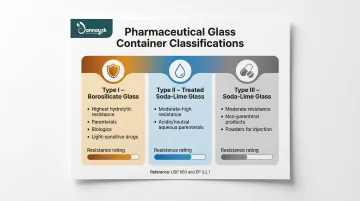
Glass remains the gold standard for many pharmaceutical applications due to its chemical inertness. Glass containers are classified by hydrolytic resistance per USP <660> and EP 3.2.1:
- Type I (Borosilicate): Highest hydrolytic resistance; suitable for most parenteral and non-parenteral products, particularly biologics and light-sensitive drugs
- Type II (Treated Soda-Lime): Surface-treated to improve hydrolytic resistance; suitable for acidic or neutral aqueous parenterals
- Type III (Soda-Lime): Moderate resistance; typically used for non-parenteral products or powders for injection
Plastics
Plastic containers offer advantages in weight, breakage resistance, and manufacturing flexibility. Common materials include polyethylene (PE), polypropylene (PP), and polyethylene terephthalate (PET). However, plastics require rigorous compatibility testing because they can:
- Leach chemical components into drug formulations
- Absorb active ingredients from solutions
- Permit oxygen or moisture transmission affecting stability
- Degrade under certain storage conditions
Metals
Aluminium and stainless steel are used for collapsible tubes, blister foil backing, aerosol containers, and pressurised delivery systems. Metals provide excellent barrier properties—complete impermeability to light, oxygen, and moisture—making them ideal for sensitive formulations.
Packaging-Drug Compatibility
FDA guidance on Container Closure Systems and ICH Q1A(R2) require stability testing to ensure packaging materials do not react with or leach into drug products. Testing protocols evaluate:
- Chemical interactions between container components and drug formulations
- Physical changes in packaging materials
- Migration of substances from packaging into the drug
- Permeation of gases or moisture through packaging barriers
Sustainable Packaging Materials
Pharmaceutical manufacturers are increasingly expected to reduce their packaging footprint — without compromising drug integrity. Emerging approaches include:
- Reduction of unnecessary outer packaging layers
- Use of recyclable materials (paper, glass, certain plastics)
- Biodegradable polymers for appropriate applications
- Applying circular economy principles throughout packaging design
Regulators including FDA, EMA, and CDSCO (India) treat drug integrity as the baseline — any sustainable material must pass the same stability and compatibility testing as conventional alternatives before it can be used in pharmaceutical products.
Anti-Counterfeiting and Security Features in Pharmaceutical Packaging
Counterfeit pharmaceuticals represent a global patient safety crisis. The WHO reports that 1 in 10 medical products in low- and middle-income countries is substandard or falsified, causing significant economic loss and patient harm. Packaging design serves as the first line of defence against counterfeiting.
Security Labelling Technologies
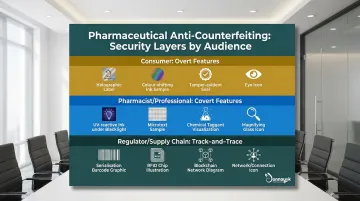
Overt Features (Visible Authentication):
- Holographic labels: Optical security elements difficult to replicate, providing immediate visual verification for consumers and pharmacists
- Colour-shifting inks: Pigments that change colour when viewed from different angles
- Tamper-evident seals: Closures and wraps that show visible evidence when breached
Covert Features (Hidden Authentication):
- UV-reactive inks: Elements visible only under ultraviolet light, enabling discreet verification
- Microtext: Extremely small text readable only under magnification
- Chemical taggants: Invisible markers detectable with specialised equipment
Track-and-Trace Technologies:
- Serialisation barcodes: Unique identifiers (QR codes, DataMatrix) enabling unit-level tracking
- RFID tags: Radio-frequency identification for automated authentication
- Blockchain integration: Distributed ledger technology for supply chain verification
Each security layer serves different audiences: consumers verify overt features like holograms, pharmacists scan barcodes, and regulators use serialisation data for supply chain oversight.
Gannayak Packaging, for instance, produces high-security holographic labels through a collaboration with IIT Kanpur using proprietary Cheko technology. Each label incorporates 3D tactile patterns, unique QR codes, and serialisation numbers — combining multiple authentication layers in a single unit.
Regulatory Serialisation Mandates
Major jurisdictions now mandate unique product identifiers on pharmaceutical packaging:
India (Exports):DGFT Public Notice 13/2015-2020 mandates barcoding on secondary and tertiary packs for export pharmaceuticals, encoding GTIN, batch number, expiry date, and serial number. In force since 2015.
European Union:Delegated Regulation (EU) 2016/161 mandates DataMatrix barcodes containing product code, serial number, batch number, expiry date, and reimbursement number (if applicable). Fully applicable since February 2019.
United States:The Drug Supply Chain Security Act (DSCSA) requires product identification at package level with interoperable electronic tracing. Full implementation of serialisation requirements effective November 2023.
Quality Assurance and GMP Compliance in Pharmaceutical Packaging
WHO GMP guidelines require pharmaceutical packaging processes to be validated to the same standard as drug manufacturing. Quality control encompasses the entire packaging lifecycle.
Incoming Materials Testing
All packaging materials must undergo routine testing before release for use:
- Visual inspection for defects
- Dimensional verification against specifications
- Physical testing (tensile strength, seal integrity)
- Chemical testing (compatibility, extractables)
- Microbiological testing (for sterile product packaging)
No packaging material should be released until it meets approved specifications.
Documentation Requirements
GMP compliance demands comprehensive documentation across four key record types:
- Batch Records — materials used, equipment settings, operators, in-process checks, and any deviations during packaging operations
- Material Specifications — dimensional, physical, chemical, and microbiological requirements for every packaging component
- Label Reconciliation Records — accounting for every label printed, issued, used, and destroyed; any discrepancy must be investigated
- Deviation Reports — documented departures from standard procedures, including root cause analysis and corrective actions
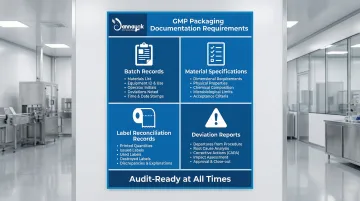
All documentation must be audit-ready for regulatory inspection at any time.
Label Control as a GMP Requirement
Printed packaging materials require stringent control:
- Secure storage with restricted access to authorised personnel
- Documented issuance, use, and reconciliation procedures
- Destruction and documentation of surplus or misprinted labels
- Verification that correct labels are used for each product
Label control failures are among the most commonly cited GMP deficiencies in FDA Form 483 observations. Recent citations include facilities where "labelling reconciliation was not performed" and inadequate quality control procedures for label approval. These failures don't just attract citations — they directly feed the consequences outlined below.
Consequences of Non-Compliance
Packaging and labelling violations carry serious consequences across both regulatory and commercial dimensions:
- FDA Form 483 observations and CDSCO show-cause notices (applicable to US export and Indian domestic operations respectively)
- Warning letters and suspension of manufacturing licences
- Mandatory product recalls with full retrieval, destruction, and notification costs
- Product liability exposure when labelling failures harm patients
- Reputational damage and long-term market share loss
In 2025, a manufacturer recalled 20 mEq Potassium Chloride Injection that had been mislabelled as 10 mEq — a dosing error with potential for fatal overdose. The result was a Class I recall, the most serious category, indicating risk of serious harm or death.
Frequently Asked Questions
What are the different types of medication labels?
Medication labels fall into four main categories: prescription drug labels (for healthcare providers), OTC Drug Facts labels (standardised consumer format), patient information leaflets or medication guides (plain-language instructions), and container/carton labels (regulatory identification). Each serves distinct communication and compliance purposes.
What information must be included on a pharmaceutical label?
WHO GMP and national regulations require the drug name, active ingredients with INN and quantities, batch number, expiry date, storage conditions, directions for use, warnings, and the manufacturer's name and address. Additional requirements vary by jurisdiction.
What is the difference between primary and secondary pharmaceutical packaging?
Primary packaging directly contacts the drug (vials, blister packs, ampoules, bottles) and must meet strict chemical compatibility, sterility, and stability standards. Secondary packaging (cartons, outer boxes) does not contact the drug but provides physical protection during distribution and carries the full regulatory labelling required for dispensing.
What are GMP requirements for pharmaceutical packaging?
GMP requires validated packaging processes, approved materials meeting documented specifications, complete batch records, and controlled storage of printed materials. Label reconciliation and in-process quality checks at every stage are mandatory, and all operations are subject to regulatory audit.
How can pharmaceutical companies prevent counterfeit drugs through packaging?
Key measures include tamper-evident closures, overt security features like holographic labels for consumer verification, and covert features such as UV-reactive inks or microtext for professional authentication. Mandatory serialisation barcodes enable end-to-end supply chain traceability from manufacturer to patient.
Which regulatory body governs pharmaceutical packaging and labelling in India?
The Central Drugs Standard Control Organisation (CDSCO) enforces pharmaceutical packaging and labelling standards in India under the Drugs and Cosmetics Act, 1940. CDSCO administers Schedule H and H1 labelling requirements for prescription medicines and mandates track-and-trace systems including barcoding for export pharmaceutical products under DGFT directives.